The Archaeological Survey of India (ASI) has informed the Madhya Pradesh High Court that a massive structure dating back to the Parmar kings existed at the Bhojshala temple-Kamal Maula mosque complex, and the current structure was built from the remains of temples.

The Anjuman Intezamia Committee Thursday filed a counter-affidavit before the Allahabad HC in the matter seeking a survey of the Wazukhana (or ablution area) by the ASI.

Days after the district court ruled that a priest can perform prayers in a cellar of the Gyanvapi mosque in Varanasi, a petitioner on Monday filled a plea seeking an ASI survey of all other closed basements in the complex.
The Allahabad high court on Thursday allowed the Archaeological Survey of India (ASI) to conduct a scientific survey at the Gyanvapi premises in Varanasi to determine whether the 17th-century mosque has been constructed over a pre-existing structure of a Hindu temple.

Hindus offered prayers at the contentious Bhojshala/Kamal Maula Mosque complex in Madhya Pradesh's Dhar district on Tuesday, with a team from the Archaeological Survey of India (ASI) continuing its court-mandated survey.

The Allahabad high court on Thursday reserved till August 3 its order on a plea against the survey of Gyanvapi mosque premises by the Archeological Survey of India.
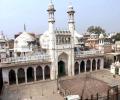
The Allahabad high court on Wednesday extended the stay on a survey of the Gyanvapi mosque premises by the Archaeological Survey of India till Thursday.

A Hindu party has filed a caveat in the Supreme Court regarding the Bhojshala complex dispute, seeking a hearing before any orders are passed on appeals against the Madhya Pradesh High Court's decision.
Gond also claimed that the Dargah premises was the meditation site of Maharaja Suheldev's guru, Rishi Balark.
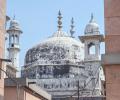
The plaintiffs submitted that the exact nature of the 'Shivling' can be determined after removing the artificial/modern walls/floors surrounding it and by undertaking a survey of the entire sealed area by excavation and using other scientific methods.
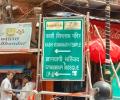
In a relief to the Hindu side, the Supreme Court on Friday refused to stay the Allahabad high court order allowing the Archaeological Survey of India (ASI) to conduct a scientific survey at the Gyanvapi mosque complex to determine if the 17th-century structure was built upon a pre-existing temple.
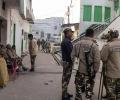
A four-member team from the Archaeological Survey of India (ASI) conducted a survey of the recently-discovered Shri Kartik Mahadev temple, five pilgrimage sites, and 19 wells in Sambhal, Uttar Pradesh, India. The survey followed the discovery of three damaged idols inside a well of the Bhasma Shankar temple, which was reopened after being shut for 46 years. The Shri Kartik Mahadev temple, also known as the Bhasma Shankar temple, was reopened on December 13 after authorities found the covered structure during an anti-encroachment drive. The temple houses an idol of Lord Hanuman and a Shivling and had remained locked since 1978. The district administration has requested carbon dating of the temple, including the well, from the ASI. Meanwhile, the Supreme Court has restrained courts across India from entertaining new lawsuits or passing any orders in pending ones seeking to reclaim religious places, especially mosques and dargahs, until further notice. This action halts proceedings in approximately 18 lawsuits filed by Hindu parties seeking surveys to determine the original religious character of 10 mosques, including the Gyanvapi at Varanasi, the Shahi Idgah Masjid at Mathura, and the Shahi Jama Masjid at Sambhal, where four individuals died in clashes. The Supreme Court will examine the legality, scope, and boundaries of the Places of Worship (Special Provisions) Act, 1991, which prohibits the conversion of places of worship and ensures the preservation of their religious character as it existed on August 15, 1947.
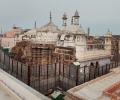
Jain told reporters that copies of the survey report consisting of 839 pages were made available to the parties concerned by the court late Thursday evening.

A Varanasi court on Tuesday fixed February 15 for the hearing of a petition seeking a survey of all closed basements in the Gyanvapi mosque complex by the Archaeological Survey of India (ASI).
The court said the parties shall give an affidavit to keep the report with them and not make it public after getting the report.

Human skeletal remains from the ancient Indus-Saraswati Civilisation site of Rakhigarhi in Haryana have been formally transferred by the Archaeological Survey of India (ASI) to the Anthropological Survey of India (AnSI) for detailed scientific investigation. This transfer, under a new MoU, aims to advance multidisciplinary research into one of the largest known settlements of the Indus-Saraswati Civilisation, with archaeologists having uncovered eight burials, including three complete skeletons, during recent excavations.

The Archaeological Survey of India (ASI) is responsible for the maintenance of 71 monuments and archaeological sites of national importance in Bihar, according to information provided to Parliament.

The Madhya Pradesh High Court has declared the disputed Bhojshala complex in Dhar to be a temple dedicated to Goddess Saraswati, suggesting the Muslim community seek land elsewhere for a mosque.
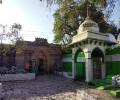
A fresh plea has been filed before the Supreme Court challenging a Madhya Pradesh High Court order, which said that the disputed Bhojshala complex in Dhar district was a temple dedicated to Goddess Saraswati.
Mishra said that the court has fixed July 7 for the next hearing.

The Madhya Pradesh High Court referenced the Supreme Court's Ayodhya verdict principles while ruling on the Bhojshala-Kamal Maula mosque complex case, determining the site to be a temple dedicated to Goddess Saraswati.

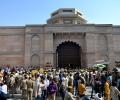
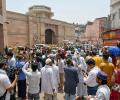
Devotees entered the Bhojshala complex in Dhar district on Saturday to offer prayers after the Indore Bench of the Madhya Pradesh high court declared the disputed Bhojshala-Kamal Maula complex a temple and granted the Hindu side the right to worship at the site.
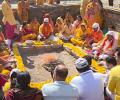
Hindu groups organised a 'victory celebration' at the historic Bhojshala complex in Madhya Pradesh's Dhar district after the ASI granted the community unrestricted access to the monument for worship.

A Solapur court has issued a temporary injunction preventing the Pandharpur temple committee from applying a chemical protective coating on the idol of Lord Vitthal. The decision came after devotees argued that modern chemicals violate religious traditions, while the committee cited preservation needs ahead of the Ashadi Ekadashi pilgrimage. The court emphasised the idol's ownership by devotees and the lack of immediate emergency for the controversial coating.
The Supreme Court ordered on Monday that no invasive work would be undertaken by the Archaeological Survey of India (ASI) to determine if the Gyanvapi mosque located next to the Kashi Vishwanath temple in Varanasi was built upon a temple and agreed to hear a plea moved by the mosque committee during the day.
The Madhya Pradesh government has challenged the legal validity of a 1935 order from the former Dhar princely state concerning the religious status of the Bhojshala Temple-Kamal Maula Mosque, arguing it cannot be considered law.
The ASI, which was to submit the report of the survey by October 6, now has time till November 6 to do so.

A non-cognisable case has been registered against three individuals for conducting a pre-wedding photoshoot at prohibited locations within the historic Raigad Fort, a site of significant cultural importance associated with Chhatrapati Shivaji Maharaj.
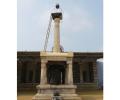
The Supreme Court has sought responses from the Centre, Tamil Nadu government, and others regarding a plea for the Archaeological Survey of India (ASI) to take over the Thirupparankundram temple and ensure daily lamp lighting on a stone pillar.
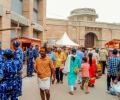
The Archaeological Survey of India (ASI) team surveyed the northern wall, the dome and basements of the Gyanvapi complex here on Tuesday, the fourth day of the court-mandated exercise to determine if the mosque was built over a temple.

Over 1,500 police personnel have been deployed around the Bhojshala in Dhar, Madhya Pradesh, ahead of the first Friday since the high court declared it a Vagdevi temple.
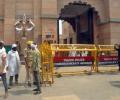
The Hindu side had claimed in the lower court that a Shivling was found during the videographic survey.
According to the counsel for the Hindu side Madan Mohan Yadav, the ASI sought more time due to non-availability of the technical report.
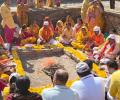
Hundreds of Hindu devotees gathered at the Bhojshala complex in Dhar, Madhya Pradesh, for a 'maha aarti' following a high court ruling declaring the site a temple. Members of the Muslim community protested peacefully by offering namaz at home wearing black bands.

Work has commenced on restoring the North and South Blocks to their original design, paving the way for the Yuge Yugeen Bharat National Museum project, with a target completion date for the first phase set for 2028.

On Friday, a four-member team of the ASI surveyed the recently-discovered Shri Kartik Mahadev temple, five pilgrimage sites and 19 'koops' (wells).

Muslim body Anjuman Intezamia Masjid committee on Thursday moved the Supreme Court against the Allahabad high court order permitting an Archaeological Survey of India (ASI) survey at the Gyanvapi mosque.

A 30-member Archaeological Survey of India team halted a survey here of the Gyanvapi mosque -- just hours after beginning the exercise Monday morning -- following a Supreme Court order.

The ASI told the court on November 2 that it might take some more time to compile the report, along with the details of the equipment used in the survey work, following which additional time till November 17 was granted for the submission of the document.

The ASI team, comprising more than a dozen members, reached the complex in the morning.
